
How Does Print on Demand Work?
How print on demand works end to end—order sync, delivery clock, money flow, and who owns which failure.
By PODListedUpdated 8 min read

Checkout fires. The customer paid. Two clocks start at once.
The first is production: a blank has to become their exact item before a carrier can move it. The second is money: card fees, product cost, print, shipping, and whatever you spent to win the click all start eating the retail price the store just collected.
Print on demand (POD) is the fulfillment model that ties those clocks together. You publish a sellable listing; after someone buys, a provider produces the unit, packs it, and usually ships it. You typically avoid funding finished goods before demand shows up—and you pay for that flexibility in unit cost, wait time, and dependence on someone else’s factory floor.
This page is the end-to-end ops view. For definition, product landscape, supplier identity, and a fuller fit checklist, use What Is Print on Demand?.
Follow one order end to end
Treat the path as a single loop, not seven disconnected tips:
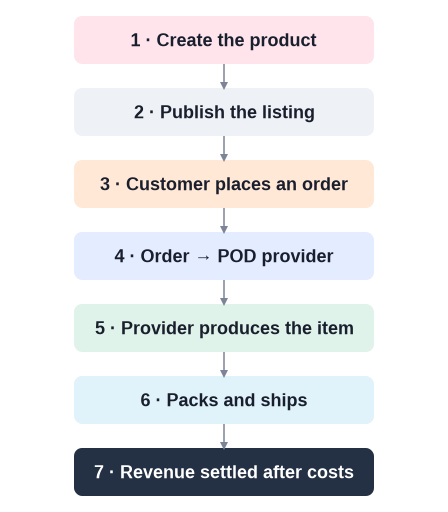
- 1. Create the product
- 2. Publish the listing
- 3. Customer places an order
- 4. Order is sent to the POD provider
- 5. Provider produces the item
- 6. Provider packs and ships
- 7. Revenue is settled after costs
1.Create the product
Pick a blank from a provider catalog—tee, mug, poster, tote—apply artwork, set placement where the catalog allows, choose variants (size, color), and set a retail price.
You are configuring a sellable SKU, not manufacturing a pallet. Physical units of that exact design and size usually do not exist until someone pays.
2.Publish the listing
The offer goes live on Shopify, Etsy, WooCommerce, or another channel you control. The storefront sells and routes the order; the POD partner prints and ships later.
In platform language, POD products are produced and shipped after a customer places an order—you sell the listing; a provider handles production and delivery.
3.Customer places an order
This is the trigger. Until checkout, there is typically no finished unit of that design and size sitting in your inventory for that sale.
Example: one hoodie sells for $48 on a US Shopify store. Production and fulfillment start from that order—not from a pre-printed bin.
4.Order is sent to the POD provider
The critical handoff is short: Customer → Online store → POD provider.
With an app or API, the order usually syncs automatically: product, variant, quantity, ship-to address, and fulfillment instructions. On Shopify, fulfillment-service apps let the store request fulfillment, track progress, and receive status updates; POD apps commonly mark items fulfilled when they ship.
If sync breaks, the customer still thinks they bought from you. Treat integration health as part of the operating model—not a side quest.
5.Provider produces the item
A blank plus your design becomes a finished unit through whatever method fits the product—DTG, DTF, sublimation, embroidery, engraving, and so on. For founders, the useful question is not “which acronym is hottest,” but whether the provider’s method fits the blank you want to sell. Confirm which suppliers list that blank under by product.
6.Provider packs and ships
After production comes processing, packing, carrier pickup, and delivery. A US order printed near the buyer and an EU order printed across a border are not the same clock. Origin, destination, carrier, and peak-season load all move the second half of the wait.
7.Revenue is settled
The parcel leaving the building is not the same event as “you earned the retail price.”
- Customer price
- Product / production cost
- −
- Fulfillment cost
- −
- Shipping
- −
- Platform / payment fees
- −
- Potential margin (before ads, tools, refunds, taxes, and time)
- =
Retail is an input. Product, decoration, shipping, and channel fees come out first. Ads, samples, refunds, tools, and your time still sit outside that line.
The delivery clock
Customers do not experience “production” and “shipping” as separate products. They experience one promise: when does it arrive?
Total delivery time ≈ production/processing time + shipping time
Both terms move. Base any estimate you publish on the provider’s real times for your product and your destinations—not a generic “3–7 days” you copied from a competitor.
Where the money actually goes
Founders misread POD when they treat checkout as profit. An order completing is not the same as keeping the retail amount.
- Customer pays $30 in sales revenue.
- Product and printing deduct $12.
- Shipping deducts $5.
- Platform and payment fees deduct $2.
- $11 remains before other costs — not final profit.
- Remaining amount still has to cover ads, samples, refunds, software, and time. Fulfillment costs are paid to the POD provider; that is a cost deduction, not the end of the money path.
Illustrative only—numbers vary by provider, product, destination, and channel. Sales channels also charge for cards and checkout services—Shopify’s public pricing lists plan fees and card rates (percentages change by plan and region). Branding add-ons, subscriptions, peak rates, and cross-border replacements move the math again; compare live details on supplier pages.
Fulfillment costs are paid to the POD provider as part of those deductions—not as the last stop on a Customer → Seller → Provider money chain. Whatever remains still has to cover acquisition, samples, refunds, software, and time. Because production sits on the critical path after the order, make-to-order fulfillment also tends to add wait versus shipping pre-made stock (Investopedia on MTO).
Who owns which failure
Split the work before something breaks—not after a one-star review.
| Activity | Seller | POD provider | Customer |
|---|---|---|---|
| Product design | |||
| Product listing | |||
| Marketing / acquisition | |||
| Places the order | |||
| Production | |||
| Packing | |||
| Shipping | Often ✓ | ||
| Customer support | Usually | Sometimes for fulfillment issues | |
| Returns / refunds | Usually seller-led | Depends on provider policy |
You usually own the customer relationship and the refund decision. The provider owns production and, typically, the outbound parcel. Read return terms before you publish a policy you cannot execute. Design quality, pricing, positioning, acquisition, and honest ship-time claims stay on your side of the table even when a partner prints and ships.
What the system changes — and what it leaves with you
POD mainly changes when production happens and who runs the press. It does not replace a business.
What it often takes off your plate
- Funding finished goods for every design before anyone buys
- Large speculative minimums tied to untested artwork
- Storing unsold finished stock
- Much of the capital lock-up that comes with holding finished goods ahead of demand
What still sits with you
- Whether anyone wants the product
- Marketing and acquisition cost
- Quality outcomes the customer attributes to your brand
- Delays you advertised (or failed to advertise)
- Returns, refunds, and support tone
- Thin margins from underpricing
- Copyright and trademark risk
If those second-list items are weak, a flawless sync to a great printer will not save the store.
Timing vs holding stock
The mechanism contrast is timing—not “POD good / inventory bad.”
| Step | Traditional inventory | Print on demand |
|---|---|---|
| 1 | Buy / manufacture stock | Create product listing |
| 2 | Store inventory | Customer places order |
| 3 | Sell | Production starts |
| 4 | Ship | Fulfillment → shipping |
| Note | Produce before demand — higher inventory risk. | Produce after the order — lower inventory risk. |
That shift is make-to-order: production begins after a confirmed order rather than before demand is known (Investopedia — MTO). It can cut excess finished-goods inventory while often adding wait and unit cost versus make-to-stock (NetSuite supply-planning glossary).
| Factor | Hold stock | Print on demand |
|---|---|---|
| Production timing | Before sale | After order |
| Finished-goods inventory | Required | Usually minimal |
| Upfront capital in stock | Higher | Lower |
| Per-unit cost | Often lower at scale | Often higher |
| Testing new designs | More expensive to wrong-size | Easier to try |
| Fulfillment | Seller / warehouse | Provider |
| Control over the press | More | Less |
POD is attractive when inventory flexibility beats the lowest possible unit cost. If volume is already predictable on stable SKUs and you need maximum unit margin or factory-level control, bulk (or a hybrid) may fit better. Broader product and supplier framing lives on What Is Print on Demand?.
One worked order
Illustrative only—change product, destination, or channel and the dollars move:
- You list a T-shirt at $30 with a design synced from a POD catalog.
- A customer buys one unit.
- The store sends size, design, and ship-to address to the provider.
- The provider prints, packs, and ships.
- The store collected $30. Product, shipping, and fees come out before anything is left for ads, refunds, or your time.
The lesson is the sequence, not a magic leftover number: demand first, production second, seller still accountable for the customer-facing business.
Is this operating model right for you?
After the order path and the money path, use a short filter. For catalogs, supplier types, and a deeper fit discussion, continue with What Is Print on Demand?.
| If your priority is… | POD may be… |
|---|---|
| Testing many ideas / minimizing finished-goods inventory | A good fit |
| Starting with limited capital for stock | Often a good fit |
| Maximizing unit margin at stable scale / full manufacturing control | Less attractive |
| Fastest possible fulfillment | Heavily provider- and location-dependent |
Next: browse suppliers or browse by product—then sample before you scale the promises you print at checkout.
Continue on PODListed
Browse suppliers by product, fulfillment options, integrations, and other business requirements — then compare options side by side.
Related guides
POD Knowledge
What Is Print on Demand?
What print on demand is, how it differs from inventory and dropshipping, and how to decide whether it fits—before you pick a supplier.
Updated Nov 27, 2026
Comparisons
Print on Demand vs Dropshipping
POD vs classic dropshipping: production timing, competition, money, returns, and fit—not just the shared zero-inventory pitch.
Updated Nov 27, 2026


Sources
- Investopedia — Make-to-order (MTO)· Checked Nov 23, 2026
- NetSuite — Supply planning glossary (make to order / make to stock)· Checked Nov 23, 2026
- Shopify Help — Fulfilling orders using a fulfillment service with an app· Checked Nov 23, 2026
- Shopify Help — Dropshipping and print on demand app recommendations· Checked Nov 23, 2026
- Shopify — Pricing (card rates / payment fees)· Checked Nov 23, 2026
- FTC — 16 CFR 435.2 Mail, internet, or telephone order sales· Checked Nov 23, 2026
- FindLaw — Shipping goods and the 30-day rule (summarizes FTC drop-shipper / fulfillment liability)· Checked Nov 23, 2026
Supplier directory fields on PODListed follow our research methodology.