
Print on Demand vs Dropshipping
POD vs classic dropshipping: production timing, competition, money, returns, and fit—not just the shared zero-inventory pitch.
By PODListedUpdated 10 min read

YouTube, Discord, and half the Shopify App Store treat “print on demand” and “dropshipping” as twins: no warehouse, no upfront stock, ship from someone else’s building. That shared surface is real—and it is the least useful fact about either model.
The useful distinction: after a customer pays, does a supplier pull a finished item that already exists, or does a partner make something to your design first?
Classic dropshipping is mostly a traffic-and-selection business. Print on demand (POD) is mostly a design-and-brand business. Both can work in many markets. They punish different mistakes, reward different skills, and compound into very different assets if you stay for years.
If you need the definition, product landscape, and supplier identity checklist, start with What Is Print on Demand?. If you need the order clock and money path inside POD, use How Does Print on Demand Work?. This page is the model-choice fork.
Same checkout, different production trigger
From the customer’s seat, both paths can look identical: they buy on your storefront; a package arrives later. Behind that seat, the paths diverge the moment payment clears.
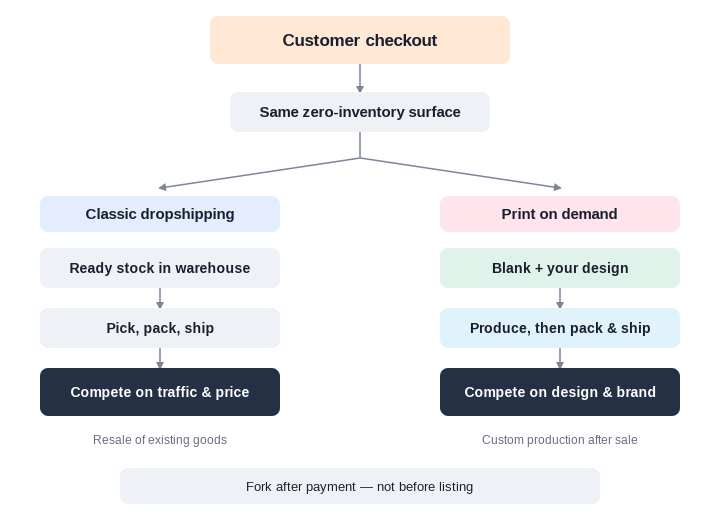
The diagram is the timing fork. What the two models compete on is different:
| Classic dropshipping | Print on demand | |
|---|---|---|
| Typical product | Standardized catalog item many sellers can list | Customized item tied to your design |
| Main edge, when it works | Selection speed, creative ads, offer testing | Design IP, niche taste, brand coherence |
| Main failure mode | Sameness + rising CAC + return drag | Weak design + slow honesty on delivery + thin niches |
Platforms sometimes call POD “customized dropshipping.” Shared trait: you typically do not hold finished inventory. Distinguishing trait: post-order production or customization. Related—not interchangeable. Shopify’s comparison draws the same line: ready-made stock versus designs applied after the sale.
What you are actually competing on
This is the section most “vs” articles skip—and the one that decides whether your first six months feel like learning or like bleeding.
In classic dropshipping, the product is rarely yours. Your supplier’s catalog is available to other stores. When a gadget trends on TikTok, dozens of shops can list a near-identical unit within days. Your competition collapses toward:
- Who finds the product earlier
- Who writes sharper ads
- Who can still clear a contribution margin after Meta/Google/TikTok takes their cut
- Who’s supplier actually ships what the listing promised
That is a performance marketing game with a merchandising wrapper. Skill here transfers. Durable product exclusivity usually does not.
In POD, the blank may be shared—but the design layer is yours. Two stores can sell the same Bella+Canvas blank; they are not selling the same shirt if the artwork, niche, and brand voice differ. Competition shifts toward:
- Whether the niche is real (search, communities, gifts, fandoms, professions)
- Whether the design language is ownable
- Whether quality and print placement match the price
- Whether you can acquire buyers without paying full retail CAC forever (email, content, marketplace SEO, audience you already have)
POD is not “easier competition.” Design saturation is real—especially on generic quote tees. The moat is niche + design system + audience, not “I uploaded a PNG.”
Example (illustrative): a general store running cold ads on a $19 desk gadget competes with every other store using the same supplier photos. A potter with 8,000 Instagram followers selling studio-motif totes on Etsy competes on recognition and taste. Same “no inventory” slogan. Different P&L drivers.
The money story (contribution, not just markup)
People ask “which has better margins?” as if the model prints a fixed percentage. It does not.
What matters is contribution per order after product cost, shipping, payment fees, expected refunds/reprints, and acquisition—then whether that contribution covers your fixed tools and time.
Industry ranges (not guarantees) for Shopify-style stores often put POD gross margins roughly in the mid tens of percent and net outcomes highly dependent on ads; general dropshipping spans even wider because ticket size and niche vary so much. Treat any single “average store nets X%” headline as a conversation starter, not a forecast.
Structural pattern worth planning around:
| Pressure | Classic dropshipping | POD |
|---|---|---|
| Unit cost vs bulk wholesale | Higher than owning inventory; often still lower than one-off print | Usually highest per unit (print + blank + one-off handling) |
| Price power | Weak when listings look identical | Stronger when design/niche is scarce |
| Ad dependence | Often high—catalog discovery is crowded | Can start on marketplace search / audience; paid ads still common at scale |
| Refund/return drag | Can be material on commodities | Often lower volume of returns, but custom items are harder to restock |
| “Sell more, lose more” risk | Classic when CAC > contribution | Classic when you underprice blanks + print + ship |
Example stack (illustrative only—not a quote from any supplier):
| Line | Amount |
|---|---|
| Retail price | $32 |
| Product + print + outbound ship | −$18 |
| Payment processing | −$1.25 |
| Refund/reprint allowance | −$1 |
| Contribution before ads | ~$11.75 |
| Paid acquisition | −$8 |
| Contribution after ads | ~$3.75 |
Swap the numbers for your niche; keep the discipline. A 55% “margin” on the product line that disappears after ads and returns is not a business model—it is a spreadsheet costume.
Shopify’s public pricing is a reminder that platform and payment fees exist in both models. They are not the differentiator. Acquisition and sameness are.
Speed, returns, and the promises you publish
Speed. Classic dropshipping can leave a warehouse the same day when stock is local. Cross-border catalog fulfillment can still take one to three weeks door-to-door—plenty of buyers have learned that the hard way. POD adds production time before the label prints: often a few business days, then transit. Local print networks narrow that gap; they do not delete it.
Honest ship windows beat optimistic ones. In the US, marketing delivery dates sits next to FTC mail-order timing rules—your storefront promises are not decorative.
Returns. NRF and Happy Returns estimated that 19.3% of online sales would be returned in 2025—an enterprise-weighted benchmark, not your niche’s destiny, but a useful gravity well for planning. Commodity dropshipping often lives closer to that world: fit issues, “not as pictured,” and easy comparison shopping.
POD usually runs a different policy shape: many providers and sellers limit returns to defects, misprints, or wrong items, because a personalized or design-specific unit does not restock cleanly. That can protect your P&L—and it can anger buyers if your listing never said so. Publish the policy you can actually execute with your supplier.
Support load follows the same split. More “where is my order / this looks different” tickets on fuzzy dropship catalogs; more “print placement / color mismatch” tickets on POD—usually fewer total tickets if quality holds, but each one is brand-visible.
How expensive the first honest test is
Both models are capital-light compared with importing a container. They are not free, and they are not equally free.
| Cost type | Classic dropshipping (typical pressure) | POD (typical pressure) |
|---|---|---|
| Store / marketplace | Shopify plan or marketplace fees | Same |
| Samples | Often useful before scaling ads | Strongly recommended—print, hand-feel, color |
| Design tools | Optional | Needed (DIY, hire, or AI-assisted drafts you still edit) |
| Forced paid traffic | Commonly required to learn anything on a new DTC store | Not mandatory on Etsy/Amazon-style search if listings rank; still common on DTC |
| Downside if week one fails | Ad spend + app stack | Samples + time on designs; usually smaller cash burn if you skip cold ads |
Example (illustrative startup envelopes): a first dropshipping test that insists on cold traffic might allocate a few hundred dollars to ads before you know anything. A first POD test on a marketplace can be samples + listing time measured in tens of dollars—if you already have designs or an audience. Neither envelope includes your time, which is the real scarce input.
If your constraint is cash and learning speed without Meta University tuition, POD often loses less while you figure out whether anyone cares. If your constraint is “I need to validate offers across ten unrelated SKUs this month,” classic dropshipping’s catalog breadth is the tool.
Moats, assets, and what survives a quiet month
Ask a brutal question: if paid traffic went to zero for 30 days, what would still be worth something?
| Asset | Classic dropshipping | POD |
|---|---|---|
| Product exclusivity | Usually weak | Design copyright / trademarkable marks (when original) |
| Brand memory | Possible, but harder when products are generic | Natural fit for merch and repeat motifs |
| Email / audience | Model-agnostic—you still have to build it | Model-agnostic—and designs give you a reason to return |
| Supplier switching cost | Often low (bad for moat, good for flexibility) | Process + file prep + print profiles; still switchable |
| Saleability of the store | Buyer discounts hard for “ads + catalog” shops | Buyers often pay more for design libraries + brand coherence—deals vary widely |
Market size context (research estimates, not your TAM): Grand View Research puts the global dropshipping market around $583.5B in 2026 (from a $464.4B 2025 base) with a 20.7% CAGR through 2033, and the global POD market around $13.1B in 2026 with a 23.6% CAGR through 2033. Different methodologies produce different headlines; treat them as scale signals. Dropshipping is the large, crowded arena. POD is smaller and still growing quickly inside customization demand—not a free blue ocean.
Survival is about edge, not category CAGR.
Which path fits you
| Situation | Lean POD | Lean classic dropshipping | Reconsider both |
|---|---|---|---|
| First store, thin budget, weak ad skills | |||
| Designer, illustrator, or creator with an audience | |||
| Building a brand you want to own in five years | Maybe as a secondary line | ||
| Strong media buyer; hunt weekly winners | |||
| Need to test many unrelated physical categories fast | |||
| Need lowest unit cost at stable volume | Wholesale / private label inventory | ||
| Need sub-3-day delivery as the hero promise | Only with proven local production | Only with proven local stock | Own warehouse may fit better |
POD may be a better fit if you can create or curate distinctive designs, tolerate longer delivery when you disclose it, and care about assets that compound (files, brand, fans).
Classic dropshipping may be a better fit if you already know how to buy traffic profitably, can enforce supplier SLAs, and accept that most “winners” decay.
Neither is a fit if you expected a fulfillment model to invent demand. The storefront, offer, and acquisition still sit with you.
When hybrid beats a pure bet
Mature operators rarely swear allegiance to a slogan. They assign jobs to SKUs:
- Stock or dropship SKUs for speed tests, accessories, or low-design commodities that support average order value.
- POD SKUs for merch, limited drops, niche apparel, and anything that should feel ownable.
- Local production where it matters—POD networks such as Gelato’s local hubs across 32 countries (vendor-reported) shrink the old “POD is always slow” caricature for many destinations near print hubs; local dropship warehouses do the same for ready stock.
AI image tools lowered the cost of drafting artwork. They did not remove taste, niche choice, print-file craft, or trademark risk. Faster drafts mean more mediocre listings, not automatic moats.
Hybrid is not two confused brands on one domain. It is one brand with two fulfillment paths, and a clear policy per SKU so customers are not surprised.
Next step
If the fork points to POD, deepen the model first—then use the directory CTAs below for live supplier data, not a static ranking:
- Concepts and fit checklist: What Is Print on Demand?
- Order path, delivery clock, money: How Does Print on Demand Work?
There is no universal winner. Pick the model that matches the skill you can actually bring to market, and only promise a delivery window you can defend.
Continue on PODListed
Browse suppliers by product, fulfillment options, integrations, and other business requirements — then compare options side by side.
Related guides
POD Knowledge
What Is Print on Demand?
What print on demand is, how it differs from inventory and dropshipping, and how to decide whether it fits—before you pick a supplier.
Updated Nov 27, 2026
POD Knowledge
How Does Print on Demand Work?
How print on demand works end to end—order sync, delivery clock, money flow, and who owns which failure.
Updated Nov 27, 2026


Sources
- Shopify — Print on demand vs dropshipping· Checked Nov 24, 2026
- Shopify Help — Dropshipping and print on demand app recommendations· Checked Nov 24, 2026
- Shopify — Pricing· Checked Nov 24, 2026
- NRF — Consumers expected to return nearly $850 billion in merchandise in 2025· Checked Nov 24, 2026
- FTC — 16 CFR 435.2 Mail, internet, or telephone order sales· Checked Nov 24, 2026
- Grand View Research — Dropshipping market (2026–2033)· Checked Nov 24, 2026
- Grand View Research — Print on demand market (2026–2033)· Checked Nov 24, 2026
- Gelato Help — Where do you print locally?· Checked Nov 24, 2026
Supplier directory fields on PODListed follow our research methodology.