
Printful Review for Beginners
A practical Printful review for beginners: how one order pays out, Free vs Growth, common pitfalls, and a clear fit check—before you connect a store or spend on ads. Live catalog facts stay on the Printful supplier page.
By PODListedUpdated 11 min read

Every “start a POD store” thread eventually points at Printful. So the real questions are not “Is Printful famous?” They are sharper:
Can a beginner make money with it?
What does one order actually leave you after fees?
Which mistakes wipe a new store before the second month?
This review is for the zero-to-early stage. It stays practical: costs, margins, setup friction, and the traps people skip past in glossy roundups. Live products, prices, and lead times still belong on the Printful supplier page—here we help you run the numbers and decide whether to start.
Printful will not invent demand for you. It can remove inventory risk and warehouse work. Whether that trade is worth it depends on your retail price, ship-to mix, and how picky you are about brand presentation.
The Printful loop
In plain terms: Printful is an all-in-one print-on-demand fulfiller. You do not buy a printer, stock finished tees, or pack boxes. After a customer pays you, Printful produces the item, packs it, and ships it.
You can hold the loop in five steps:
- Connect Printful to your store (Shopify, Etsy, WooCommerce, and many others).
- Upload artwork in their design tools, publish products, set your retail price.
- A buyer checks out on your store; the order syncs to Printful.
- Printful prints, checks, packs—and can apply your branding options where you paid for them—then ships to the buyer.
- You keep retail price minus Printful’s bill, platform fees, and any ads or refunds.
You own the store and the traffic. Printful owns production and outbound shipping. That split is the whole model. If you still need the broader POD definition, read What Is Print on Demand?; for the operating clock, see How Does Print on Demand Work?.
Beginner basics you need before the math
What can you sell?
Printful is a generalist catalog: apparel (tees, hoodies, headwear, and more), home and lifestyle (mugs, posters, tote bags, pillows, blankets), and adjacent merch (phone cases, stickers, pet items, and similar). Official pricing pages recently describe access to on the order of 600+ custom products—enough for early testing without wiring five vendors on day one. Exact counts move; confirm on the live Printful profile and Printful’s catalog.
Beginner note: breadth is a tool, not a merchandising strategy. A store that lists “everything Printful sells” usually converts like a flea market.
How do you pay? Is there a gate fee?
Printful is pay-per-order: no inventory deposit, no minimum order quantity. You pay when something sells (or when you buy a sample).
Two plans matter for beginners (Printful pricing / plans):
| Plan | Ballpark fee | What beginners should remember |
|---|---|---|
| Free | $0 / month | Full catalog access, integrations, fulfillment. Start here. |
| Growth | About $24.99 / month (currency variants exist) | Published perks include up to ~33% off many product prices, ~9% off branding, ~25% off samples. Printful also states Growth can be free for a year once yearly sales hit $12,000 (eligibility rules apply—confirm in their help center). |
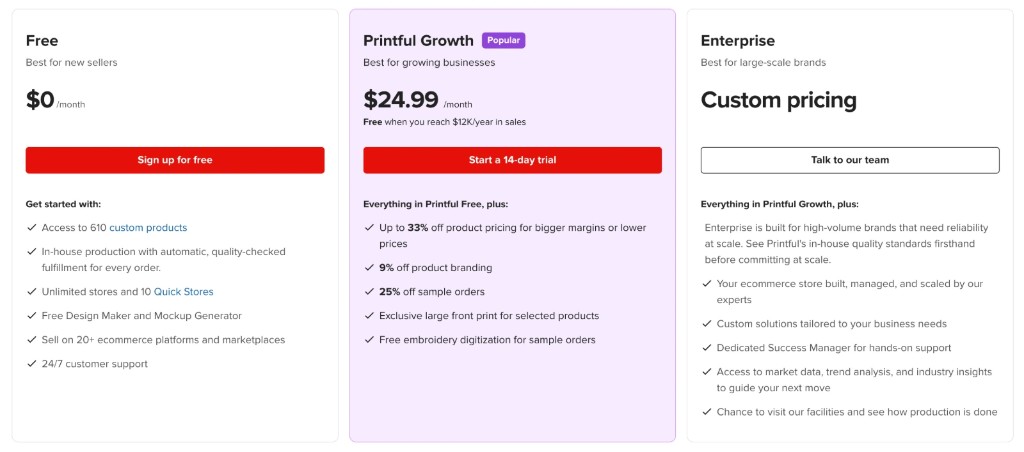
Product base prices typically include the blank, one print/embroidery placement, and fulfillment. Shipping, tax, extra placements, labels, and branded packaging are separate. Sample discounts and monthly sample limits also change with plan and volume—check current rules before you assume unlimited free prototypes.
Practical rule: stay on Free until order flow is real. Growth only pays for itself when the product discount on your SKUs exceeds the subscription—and when you would have sold those units anyway.
Which store platforms work?
Beginners usually need Shopify, Etsy, or WooCommerce. Printful lists native apps for those and a long list of other store/marketplace connections (Amazon, eBay, Wix, TikTok Shop, API, and more in PODListed’s catalog). Walmart is marked unsupported in the current PODListed integration matrix—if that channel is your plan, do not force-fit Printful.
Orders can sync automatically and tracking can return to the store when the integration is set up correctly. Still verify your channel on the live profile before you promise “hands-off” ops.
Beginner P&L — tee, hoodie, mug
This review keeps the classic starter trio. Marketplace provider-spread math and décor poster math live in the Printify review and Gelato review.
Beginners obsess over blank prices. Pros obsess over landed cost: product + print + shipping + platform fees (+ branding if you add it).
Below are illustrative US domestic examples built from public catalog-style figures circulating around November 2026 (Bella+Canvas 3001 ≈ $11.92 base on Free; standard US tee shipping often cited near $4.95 first item; Gildan 18500 hoodie bases and ship bands from public reviews of the same catalog window). They are not a live quote.
Assumptions (examples):
- One item, one standard front print, Free plan unless noted
- US destination, standard shipping band
- Retail prices are common starter shelves—not a recommendation
- Shopify-style card fee modeled as 2.9% + $0.30 (Basic-plan style online rate—confirm your plan and region)
- No ads, no returns, no tax pass-through complexity, no holiday surcharges
- Growth column assumes roughly the published ceiling (~33% off product price only)—your SKU may receive less; shipping usually does not get that discount
Re-price in Printful’s dashboard (and your checkout) before you publish.
Example 1 — Bella+Canvas 3001 tee (DTG, front print)
| Line | Free plan (example) | Growth @ ~33% off product (example) |
|---|---|---|
| Product + one print (Printful) | $11.92 | ≈ $7.99 |
| US standard shipping (1st item) | $4.95 | $4.95 |
| You pay Printful | $16.87 | ≈ $12.94 |
| Your retail price | $29.99 | $29.99 |
| Platform fee (2.9% + $0.30) | ≈ $1.17 | ≈ $1.17 |
| Cash left before ads/refunds | ≈ $11.95 | ≈ $15.88 |
| Margin on retail | ≈ 40% | ≈ 53% |
At a $24.99 retail on Free, the same cost lines leave roughly $7—which is why matching the cheapest tee on a marketplace still fails if ads or returns show up.
Example 2 — Gildan 18500 hoodie (DTG, front print)
| Line | Free plan (example) | Growth @ ~33% off product (example) |
|---|---|---|
| Product + one print | ≈ $22.63 | ≈ $15.16 |
| US shipping (band often higher than tees) | ≈ $8.79 | ≈ $8.79 |
| You pay Printful | ≈ $31.42 | ≈ $23.95 |
| Your retail price | $49.99 | $49.99 |
| Platform fee (2.9% + $0.30) | ≈ $1.75 | ≈ $1.75 |
| Cash left before ads/refunds | ≈ $16.82 | ≈ $24.29 |
| Margin on retail | ≈ 34% | ≈ 49% |
Hoodies raise AOV. They also raise shipping and return risk. Price the door-to-door story, not the blank alone.
Example 3 — 11 oz white mug (sublimation-style drinkware)
Drinkware is useful as an add-on or gift SKU. Exact Printful bases move by warehouse and finish; treat this as a structure demo, then pull the live mug SKU you will sell.
| Line | Free plan (structure) | Notes |
|---|---|---|
| Product + print | Pull live quote | Often a few dollars on Free for basic white mugs—confirm |
| Shipping | Pull live quote | Ships as its own parcel logic more often than apparel add-ons |
| Retail | e.g. $16.99–$19.99 | Common gift-price band |
| Platform fee | 2.9% + $0.30 on retail | |
| Leftover | Retail − Printful − fee | Usually thinner dollars than apparel, useful for basket-building |
Do not paste a blog’s mug number into your Shopify price list. Open the SKU, set the destination, and read the quote.
Three beginner traps on Printful math
- Shipping is often 25–40% of what you pay Printful on a single apparel order. Storefront “free shipping” is your retail decision.
- Stay on Free until order flow is real. Growth only helps after the discount on your volume beats the fee.
- Etsy fees are a different P&L than the Shopify-style examples above—raise retail or expect a tighter leftover.
For a fuller money-flow walkthrough of POD in general, see How Does Print on Demand Work?—then come back here for Printful-specific fit.
Where beginners usually benefit
If most orders are in North America or Western Europe and you would rather not rank printers, I would start on Printful Free. If the plan is to swap plants for the cheapest blank on every SKU, compare a marketplace before you commit.
1.Low setup friction
Native apps for major stores, a mockup/design tool, and automatic order sync reduce the “I need a developer” delay. You can spend early hours on offer and traffic instead of CSV babysitting—if your channel is supported.
2.More predictable ops than a pure random-printer marketplace
Printful combines in-house production and a partner network, with multi-location routing. Official help content frames typical fulfillment (produce + pack) in about 2–5 business days, excluding transit—aligned with what PODListed stores as an official estimate on the Printful profile. That is not a promise for every SKU and warehouse, and it is not door-to-door speed. It is a clearer SLA story than “whichever third-party printer you clicked.”
3.Branding levers (when you pay for them)
This is a real differentiator versus many ultra-cheap POD setups:
- White-label presentation on apparel/accessories (as catalogued)
- Custom inside/outside labels (Printful publishes per-label add-ons—e.g. inside labels commonly listed near $0.99)
- Packing inserts and branded packaging on selected products
- No Printful logo on the customer experience when you use the white-label path correctly
If you care about repeat buyers and a coherent unboxing, these tools matter. If you only care about the lowest possible COGS, they are optional cost—not a reason to pretend the cheap path is identical.
Four pitfalls that quietly kill new stores
1.Assuming “ships worldwide” means “fast and cheap everywhere”
Printful’s production/fulfillment footprint is strongest across North America, Europe/UK, and additional partner locations (see their fulfillment-center help and the live origins on PODListed). Far destinations can mean higher shipping and longer transit.
Beginner move: launch with NA + Western Europe demand first. Do not open with “free worldwide shipping” as a vanity badge.
2.Forgetting branding is billed per unit
Labels, inserts, and mailers are productized services, not free defaults. A $0.99 label on a skinny-margin tee can erase the week’s ad budget math.
Beginner move: launch with basic white-label if needed; add paid packaging after contribution margin is proven.
3.Turning the catalog into a junk drawer
Six hundred products feel like opportunity. To a customer, they feel like confusion.
Beginner move: one audience, one promise, 1–2 product types (example: cat-illustration tees + one mug). Depth beats aisle-wandering.
4.Running ads before a sample lands
Mockups lie politely. Fabric weight, print crackle, hoodie shrink, and mug color shift do not.
Beginner move: order at least one hero sample from the same product, print method, and—when possible—region you will sell. Free plan sample discounts exist; use them before Meta or TikTok spend.
Fit self-check
Printful is often a sensible first fulfiller if several of these are true:
- Primary buyers are in North America and/or Europe
- You want one generalist account (apparel + merch) instead of five logins
- Brand presentation matters (labels/packaging on the roadmap)
- You prefer fewer quality variables over hunting the absolute cheapest printer
- You can live with POD unit economics after honest landed-cost math
- Your channel is supported (Shopify / Etsy / WooCommerce are the usual beginner trio)
Compare harder (or pick another model) if:
- Your only strategy is lowest blank price
- Walmart (or another unsupported channel) is core
- You want to pick a different print partner for every SKU (marketplace-style suppliers fit that job better)
- You sell a niche Printful barely covers
Five things to do before you “open”
- Create a Free account and browse live quotes for the two SKUs you might actually sell.
- Order 1–2 samples of the hero product; ship them to yourself from a relevant region.
- Build a one-order P&L — product + ship + platform fee + optional branding; set retail so contribution stays healthy after a realistic ad or discount line (many operators use ~30%+ contribution as a personal floor—your floor may differ).
- Confirm the channel integration you need, including how tracking returns to the store.
- Write honest shipping copy — production window plus transit. Printful’s 2–5 business day fulfillment band is not the same as “arrives in 2–5 days.”
Alternatives in context
If Printful is a “maybe,” compare shapes—not blog trophies:
| Printful | Printify | Gelato | |
|---|---|---|---|
| Model | Integrated fulfiller (in-house + partners) | Print marketplace (you choose providers) | Global local-production network |
| Price posture | Mid | Often lower on comparable blanks | Mid / varies by node |
| Consistency story | Stronger single-account QC narrative | Depends heavily on the printer you pick | Network-dependent |
| Branding tools | Relatively strong | Often lighter | Moderate |
| Often fits | Beginners who want one stable branded path | Sellers optimizing cost per SKU | Sellers prioritizing local production / certain print categories |
Live data beats this sketch:
Supplier comparison
Live directory data — not a static ranking table.
| Factor |  PrintfulPOD Fulfillment Provider |  PrintifyPOD Network |  GelatoPOD Network |
|---|---|---|---|
| Main product focus | Activewear, All-Over-Print Apparel (legacy facet), Apparel, Backpacks | Activewear, All-Over-Print Apparel (legacy facet), Apparel, Backpacks | Calendars, Candles, Caps, Framed Prints |
| Popular sales channels | Shopify, Etsy, WooCommerce, Amazon | Shopify, Etsy, WooCommerce, Amazon | Shopify, Etsy, WooCommerce, Amazon |
| Fulfillment time | 2–5 days | 2–7 days | — |
| Branding capabilities | Blind shipping / white-label, Branded packaging, Custom labels, Packaging inserts | Blind shipping / white-label, Custom labels, Packaging inserts | Blind shipping / white-label, Branded packaging |
| Ships from | Australia, Brazil, Canada, Japan | Australia, Canada, China, Czechia | Australia, Canada, China, Germany |
| Pricing model | Pay per order | Pay per order, Subscription plan | Subscription plan |
Use /compare when you are ready to put two or three suppliers side by side. For the full head-to-head decision frameworks, see Printful vs Printify and Printful vs Gelato.
Start here
Printful is not the cheapest POD option by default. For many beginners it is still one of the clearest first accounts: free to start, familiar apps, branding levers, and a fulfillment story you can explain to customers—if you price like an operator and sample like a skeptic.
A durable beginner path looks like this: Free plan → sample the hero SKU → tiny traffic test → only then Growth, extra branding, or catalog sprawl.
- Check live products, origins, and integrations on the Printful supplier page.
- Compare two backups in
/compare. - Register Free, pull real quotes, and order the sample that decides the next ninety days.
Alternatives to consider
Continue on PODListed
Browse suppliers by product, fulfillment options, integrations, and other business requirements — then compare options side by side.
Related guides
Comparisons
Printful vs Printify — How to Choose in 2026
Neutral Printful vs Printify comparison for ecommerce sellers: integrated fulfiller vs print marketplace, illustrative landed margins, branding and QC trade-offs, and when a second account is worth opening. Live data stays on /compare.
Updated Nov 27, 2026
Comparisons
Printful vs Gelato — How to Choose in 2026
Neutral Printful vs Gelato comparison for ecommerce sellers: integrated fulfiller vs local-production network, apparel vs wall-art fit, illustrative landed margins, and how to split apparel from décor if you use both. Live data stays on /compare.
Updated Nov 27, 2026
POD Knowledge
What Is Print on Demand?
What print on demand is, how it differs from inventory and dropshipping, and how to decide whether it fits—before you pick a supplier.
Updated Nov 27, 2026


Sources
- Printful — Pricing· Checked Nov 24, 2026
- Printful — Plans / Growth· Checked Nov 24, 2026
- Printful Help — What should I know about the Growth plan· Checked Nov 24, 2026
- Printful Help — How long does it take to fulfill an order· Checked Nov 24, 2026
- Printful Help — Fulfillment center locations· Checked Nov 24, 2026
- Printful — Custom packaging· Checked Nov 24, 2026
- Shopify App Store — Printful· Checked Nov 24, 2026
Image credit
Supplier directory fields on PODListed follow our research methodology.