
Printify Review — Marketplace POD & Real Margins
A practical Printify review for ecommerce founders: how the marketplace model works, Free vs Premium break-even, illustrative unit economics, and the pitfalls of multi-printer fulfillment—before you scale ads. Live catalog facts stay on the Printify supplier page.
By PODListedUpdated 10 min read

Most Printify roundups sell the same sentence: cheaper blanks, bigger catalog, start free. That sentence is incomplete.
The useful questions are different:
Are you willing to manage printers—or do you want one fulfiller personality?
Does Premium actually pay for itself on your SKUs?
What does one US order leave after shipping and platform fees?
Where does the marketplace model quietly burn a new shop?
Aimed at operators who will actually rank printers—not readers looking for a motivational app. Live catalog fields stay on the Printify supplier page. Sister P&Ls for integrated and local-network models: Printful review · Gelato review.
Printify lowers the cash you risk per test SKU only if you treat provider choice as the job.
How the marketplace order path works
Printify is a print marketplace: your store connects to independent Print Providers, and you (or Choice routing) assign who prints each SKU. Public materials describe a large multi-provider roster and a wide catalog—confirm current counts on the live profile rather than memorizing a blog number.
Typical path: connect a channel → pick product and provider → publish your retail price → order syncs to that factory → you keep retail minus product, shipping, platform fees, ads, and refunds.
You own the store, traffic, and provider picks. Printify owns the marketplace software. The factory owns print quality. Two shops on “Printify” can feel unrelated for that reason.
If you still need the broader POD definition, read What Is Print on Demand?. For the operating clock of money and fulfillment, see How Does Print on Demand Work?.
One sentence vs an integrated fulfiller
- Integrated fulfiller (e.g. Printful): fewer printer personalities, stronger single-account branding story, usually higher blank prices.
- Marketplace (Printify): lower prices and more SKU-level choice, in exchange for screening work and quality variance.
Neither shape is “better.” They optimize different jobs.
The operator skill: choosing Print Providers
Catalog breadth is the bait. Provider selection is the business.
On a popular blank, you may see a dozen providers with different base prices, shipping bands, production windows, and review scores. Two sellers can publish the “same” Bella+Canvas tee on Printify and get opposite customer experiences—because they locked different factories.
What to compare before you publish a hero SKU:
| Dimension | Why it matters |
|---|---|
| Provider rating + volume | Thin samples of five-star praise are weak; look for sustained volume and recent reviews |
| Production location | Local production cuts transit and often shipping; cross-border can erase a “cheap blank” |
| Base price and shipping | A $1-cheaper blank with $3-higher shipping is not cheaper |
| Production window | Peak season stretches every network; niche providers stretch first |
| Branding options | Neck labels / inserts are provider-dependent—not a platform-wide default |
Printify Choice (where offered) routes orders automatically to a competitive provider at a fixed listed price. It reduces decision load. It also means you may not know which factory handled a given unit—fine for testing volume, riskier if you need a fixed quality story.
Operator rule: treat provider choice like hiring. Interview with samples. Promote only the ones that survive a real unboxing.
Free vs Premium — when the fee pays for itself
Printify is pay-per-order: no inventory deposit, no MOQ. Free is a real plan, not a demo.
| Plan | Ballpark fee | What operators should remember |
|---|---|---|
| Free | $0 / month | Full catalog, integrations, up to 5 connected stores. Start here. |
| Premium | $39 / month, or $299 / year (about $24.99 / month) | Up to ~20% off most catalog products; up to ~33% off select new products and neck labels; Printify Connect for eligible order issues; up to 10 stores; AI mockup attempts; early feature access |
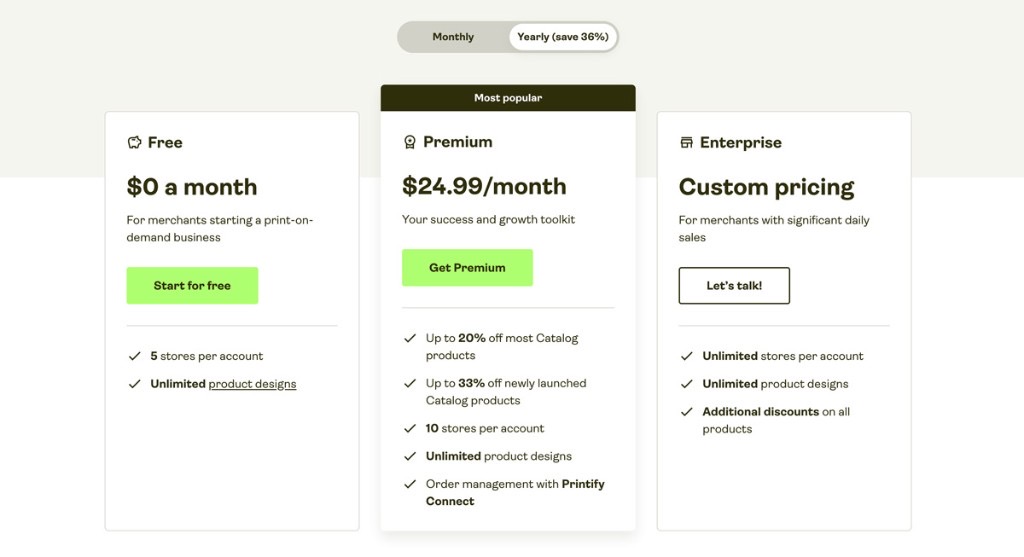
Exact plan language changes—confirm on Printify pricing and their Premium help article before you upgrade.
Break-even framing (official-style math, not a promise): at a full 20% product discount, Printify’s own pricing page recently framed monthly Premium as paying for itself around ~$195 of monthly product costs (yearly billing break-even nearer ~$125 of product costs). Shipping usually does not get the Premium cut.
Practical rule: stay Free until you have repeatable order flow. Premium is a margin amplifier for SKUs you already sell—not a growth strategy for a quiet store.
Provider spread is the real P&L lesson
Integrated-fulfiller reviews walk a single blank through Free vs paid. On Printify the first homework is different: same blank, two providers. Figures below are illustrative structure (~Nov 2026), not a live quote. Shopify fee ≈ 2.9% + $0.30.
Same Bella+Canvas 3001 — Choice-style vs a cheaper qualified plant
| Line | Mid-tier / Choice-style Free | Cheaper qualified provider Free |
|---|---|---|
| Product + print (US public bands) | often near $11.29 | commonly $1–$3 lower—pull live |
| US shipping | often near $4.95 | can be higher or lower—pull live |
| Retail $24.99 after fee | leftover near $7–$8 on mid-tier | leftover rises only if shipping does not erase the product cut |
Premium (~20% off product on many SKUs) amplifies whichever provider you already locked. Screen first; subscribe second. At $29.99 retail the leftover widens, but ads and reprints still dominate.
Phone case or tote as a catalog-width test
Pick one accessory Printify carries that a narrower catalog may not. Quote product + shipping to your ZIP on Free. These SKUs are for testing niches and baskets—not for crowning Printify over an apparel-first fulfiller. If the case ships as its own parcel, shipping can rival the blank the same way drinkware does elsewhere.
Two marketplace rules
- Provider spread can beat Premium. A few dollars between plants often matters more than the subscription in month one.
- Storefront “free shipping” is your pricing decision. Printify does not gift the ship line.
Where Printify usually wins
1.Lower blank posture on comparable SKUs
On many shared apparel blanks, Printify’s Free-plan quotes often sit below integrated fulfillers—sometimes by a noticeable gap once Premium applies. That matters for volume testing, price-sensitive niches, and multi-store matrices where every dollar of COGS compounds.
2.Catalog width for cheap experiments
Two thousand-plus products means you can probe apparel, drinkware, wall art, phone cases, and oddball merch without opening five vendor accounts. Breadth is a testing tool. It is not a merchandising strategy—stores that publish “everything in the catalog” convert like thrift aisles.
3.SKU-level control
Open one blank, for example a Bella+Canvas 3001, and compare three providers on price, origin, and recent reviews. Then order the hero size from the provider you would actually lock. The marketplace lets you assign that choice per product. Integrated fulfillers usually trade that flexibility for consistency.
4.Real Free plan
Five store connections, full catalog access, and the same provider network as paid plans means you can validate the full path—connect, publish, sample, sell—before you spend on Premium.
5.Channel coverage
Native connections cover the usual Shopify / Etsy beginner path plus marketplace and social storefronts many founders already use. Printify also offers a hosted Pop-Up Store if you need a temporary storefront. Always confirm the specific channel on the live Printify profile.
Marketplace costs beginners underestimate
1.Quality is a distribution, not a brand promise
This is the core trade. Providers are vetted and ranked, but they are still independent factories. Print clarity, hand-feel, sizing tolerance, and packing discipline vary. A bad pick shows up as reviews on your store, not on Printify’s homepage.
Operator move: shortlist providers rated highly with real volume; sample the hero SKU from the exact provider you will lock; keep a backup provider pre-configured for peak season.
2.Branding is patchy by design
Neck labels, inserts, and packaging upgrades exist—but availability and pricing depend on the provider. If unboxing and identity are the product, an integrated fulfiller with packaged branding options may fit better than hunting those options across a marketplace.
3.Support speed is not a dedicated ops desk
Printify publishes 24/7 merchant support and chat. Free-plan queues and multi-provider investigations still take time. Premium’s Printify Connect can take eligible order issues off your plate—useful once volume makes ticket load real. Peak season compresses everyone’s response window.
4.Peak season exposes thin capacity
Popular blanks have options. Niche SKUs may have one or two providers. Black Friday and Christmas stretch production windows and transit. Publish production + shipping as one customer promise, not the production band alone.
5.Stale listings and sync edge cases
Sellers periodically report idle products disappearing from catalogs, and multi-currency stores can see price sync quirks when numbers move between currencies without a careful check.
Operator move: keep local design backups; after every publish, open the live storefront and verify the customer-facing price and shipping copy.
6.Samples are not a free playground
Unlike some competitors’ sample discount programs, Printify samples generally price like normal production (confirm current rules in-account). Budget samples as R&D, not as freebies.
Fit self-check
Printify is often a strong primary account if several of these are true:
- You will actively compare providers (or deliberately use Choice) instead of assuming “Printify quality”
- You want aggressive testing across many designs / product types at lower blank cost
- You run—or plan—multiple storefronts and need more than one connection
- Margin per unit matters more than a single branded unboxing system on day one
- You are comfortable ordering samples and killing weak providers early
- Your channel is supported on the live integration list
Compare harder (or start elsewhere) if:
- You want one consistent factory personality and strong out-of-the-box branding
- You refuse to spend time screening printers
- Premium packaging / identity is the product, not an add-on
- You need white-glove, high-volume account ops from day one
- Your niche demands ultra-tight process control few marketplace nodes can match
Operator checklist before you scale ads
- Open Free, pick two SKUs you might actually sell, and compare at least three providers on landed cost (product + ship) to your main buyer region.
- Order one sample from the provider you intend to lock—same blank, print method, and region story you will sell.
- Build a one-order P&L — product + ship + platform fee + optional branding; set retail so contribution survives a realistic ad or discount line.
- Write shipping copy as a sum — production window plus transit. Do not paste “2–5 business days” as door-to-door.
- Upgrade to Premium only after the discount on real monthly product spend beats the fee (use Printify’s ~$195 product-cost frame as a starting heuristic, then verify on your SKUs).
- Keep a backup provider for the hero SKU before peak season.
Alternatives in context
If Printify is a “maybe,” compare shapes—not affiliate trophies:
| Printify | Printful | Gelato | |
|---|---|---|---|
| Model | Print marketplace (you choose providers) | Integrated fulfiller (in-house + partners) | Global local-production network |
| Price posture | Often lower on comparable blanks | Mid | Mid / varies by node |
| Consistency story | Depends on the printer you lock | Stronger single-account QC narrative | Network-dependent |
| Branding tools | Often lighter / provider-specific | Relatively strong | Moderate |
| Often fits | Operators optimizing cost + tests per SKU | Beginners who want fewer moving parts | Sellers prioritizing local production / certain print categories |
Live data beats this sketch:
Supplier comparison
Live directory data — not a static ranking table.
| Factor |  PrintifyPOD Network |  PrintfulPOD Fulfillment Provider |  GelatoPOD Network |
|---|---|---|---|
| Main product focus | Activewear, All-Over-Print Apparel (legacy facet), Apparel, Backpacks | Activewear, All-Over-Print Apparel (legacy facet), Apparel, Backpacks | Calendars, Candles, Caps, Framed Prints |
| Popular sales channels | Shopify, Etsy, WooCommerce, Amazon | Shopify, Etsy, WooCommerce, Amazon | Shopify, Etsy, WooCommerce, Amazon |
| Fulfillment time | 2–7 days | 2–5 days | — |
| Branding capabilities | Blind shipping / white-label, Custom labels, Packaging inserts | Blind shipping / white-label, Branded packaging, Custom labels, Packaging inserts | Blind shipping / white-label, Branded packaging |
| Ships from | Australia, Canada, China, Czechia | Australia, Brazil, Canada, Japan | Australia, Canada, China, Germany |
| Pricing model | Pay per order, Subscription plan | Pay per order | Subscription plan |
Use /compare when you are ready to put two or three suppliers side by side. For marketplace vs local-network head-to-head, see Printify vs Gelato. For the integrated-fulfiller fork, see Printful vs Printify. For a beginner-focused read on the integrated path, see our Printful review.
Put it to work
Printify is not “the cheapest POD company, full stop.” It is one of the clearest marketplace accounts in the category: Free to enter, wide catalog, SKU-level provider control, and Premium discounts that reward real volume—if you treat printer selection as part of the job.
A durable path looks like this: Free plan → lock providers with samples → tiny traffic test → Premium only when discounts out-earn the fee → keep an integrated fulfiller in reserve for brand-critical SKUs if you need that consistency later.
- Check live products, origins, and integrations on the Printify supplier page.
- Compare backups in
/compare. - Register Free, pull real quotes, and order the sample that decides whether the marketplace model is yours to run.
Alternatives to consider
Continue on PODListed
Browse suppliers by product, fulfillment options, integrations, and other business requirements — then compare options side by side.
Related guides
Comparisons
Printify vs Gelato — How to Choose in 2026
Neutral Printify vs Gelato comparison for ecommerce sellers: print marketplace vs local-production network, apparel vs wall-art fit, illustrative landed margins, and when the free-plan store limits actually matter. Live data stays on /compare.
Updated Nov 27, 2026
Comparisons
Printful vs Printify — How to Choose in 2026
Neutral Printful vs Printify comparison for ecommerce sellers: integrated fulfiller vs print marketplace, illustrative landed margins, branding and QC trade-offs, and when a second account is worth opening. Live data stays on /compare.
Updated Nov 27, 2026
POD Knowledge
What Is Print on Demand?
What print on demand is, how it differs from inventory and dropshipping, and how to decide whether it fits—before you pick a supplier.
Updated Nov 27, 2026


Sources
- Printify — Pricing· Checked Nov 25, 2026
- Printify Help — How does Printify’s Premium plan work?· Checked Nov 25, 2026
- Printify — Network & fulfillment status· Checked Nov 25, 2026
- Printify — Shipping rates· Checked Nov 25, 2026
- Printify — Reviews· Checked Nov 25, 2026
- Shopify App Store — Printify· Checked Nov 25, 2026
- PODListed — Printify supplier page· Checked Nov 25, 2026
Image credit
Supplier directory fields on PODListed follow our research methodology.